
QuantyPhi Quarterly
A Message from the President

I want to take a moment to share what continues to drive our work at QuantyPhi and why we are so excited about where things are headed.
Over the past several years, we have had countless conversations with credit unions about the growing complexity of balance sheet management. More data, more models, more regulatory pressure, and more decisions that all need to align. Those conversations ultimately shaped ALM360, our integrated balance sheet management platform. What began as a vision has become a reality, and we are incredibly excited about what this platform means for the credit unions we serve.
ALM360 brings together ALM, CECL, liquidity, financial simulation, trading, and performance analytics within a single, connected environment. The goal is simple: reduce fragmentation, improve consistency, and give credit unions a clearer line of sight from strategy to execution. By using shared data and assumptions across modules, ALM360 helps credit unions model decisions, understand tradeoffs, and move forward with confidence, whether preparing for ALCO, responding to examiners, or planning ahead.
What excites me most is not just the technology itself, but the potential it creates as credit unions begin to put it to work. We are excited about the opportunity for stronger conversations at the ALCO table, better alignment across teams, and more thoughtful decision making built on consistent numbers and integrated analysis. That’s the outcome we believe ALM360 is designed to support, and we are excited to see how credit unions leverage it over time.
As always, our role at QuantyPhi remains the same: to be a trusted partner focused on helping credit unions build resilient, well managed balance sheets. Thank you for your continued trust and collaboration, and I hope you find this edition of the QuantyPhi Quarterly both useful and relevant.
Warm regards,
 Adam Stone
President of QuantyPhi
Innovative Solutions for a Thriving Credit Union
See risk more clearly with ALM360’s ALM Modeling.
ALM Modeling within ALM360 gives your credit union deeper insight into how rate changes and strategic decisions impact earnings and risk across the balance sheet. Explore how instrument level modeling and scenario analysis can turn regulatory requirements into clearer, more confident decision making.

Simplified ALM Modeling offers strategic insight without the heavy lift.
Simplified ALM Modeling offers a fast, accessible way to gain meaningful balance sheet insight using Call Report data alone. It delivers essential projections and scenario analysis to support strategic discussions without the complexity of full data onboarding. Learn how this streamlined approach helps credit unions participate confidently in ALCO and board level decision making.
Flexible CECL modeling built for your credit union.
CECL Modeling in ALM360 provides flexible, compliant credit loss forecasting using methodologies designed to fit your credit union’s size and portfolio complexity. Choose between PD LGD or SCALE to support accurate allowances, consistent assumptions, and confident regulatory discussions. See how integrated CECL modeling strengthens governance and simplifies ongoing compliance.
Integrated Balance Sheet Intelligence for Stronger Leadership Decisions
From siloed models to connected insight.
Adam Stone, President of QuantyPhi, examines why balance sheet decisions remain difficult even as modeling tools grow more sophisticated. When earnings, liquidity, and risk are analyzed in separate systems, leaders lose valuable time reconciling data instead of evaluating strategy. This causes delays and reduces clarity when it matters most.
The article makes the case for a more connected approach, where ALM, liquidity, and credit risk are analyzed together using shared data and assumptions. With integrated balance sheet intelligence, leaders gain faster scenario insight, clearer communication with boards and regulators, and a stronger foundation for strategic decision making in a rapidly changing environment.
Market Commentary
March Madness and Market Mayhem
By: Wade Cooper, MBA, Financial Strategist
Every March, millions of fans confidently fill out NCAA tournament brackets, convinced this year will be different. Favorites usually win, but upsets come fast. By the end of the first weekend, even the most carefully researched predictions are in shambles. Since the bracket expanded to 64 teams in 1985, a No. 1 seed has won the tournament 26 times, which is 65% of the time. Picking a No. 1 seed to win is a solid bet, but there are four of them. So, which one do you choose? In 40 tournaments, the Final Four has been made up entirely of No. 1 seeds only twice. In other words, in 95% of tournaments, at least one top seed doesn’t even make it that far.
Financial markets often feel just as messy and unpredictable.
In the first two months of the year, the Dow Jones Industrial Average crossed the 50,000 mark, while the S&P 500 briefly flirted with 7,000. Gold surged to an all‑time high before pulling back modestly, while silver made its own record run only to retreat far more sharply. Adding another twist, the Supreme Court’s decision to strike down key tariffs removed one variable from the inflation and trade outlook but replaced it with new uncertainty. All of this happened before the end of the first quarter of 2026.
Layered on top of market volatility is a pending change in Federal Reserve leadership. While not yet official, Kevin Warsh has been named as the expected nominee for Fed Chair, subject to Senate confirmation. The prevailing narrative is that a new chair could be more favorable toward rate cuts. Market pricing tells a different story. World Interest Rate Probabilities currently imply only about three cuts over the next year. The disconnect is striking. If policy leadership is expected to turn more dovish, why aren’t markets pricing in more aggressive easing?
The answer lies in the fundamentals.
Inflation has cooled from recent highs, but it remains above long‑term targets. At the same time, unemployment has stayed historically low despite higher interest rates. That combination leaves the Federal Reserve with limited urgency to move quickly. As a result, interest rates remain elevated, and the timing, pace, and magnitude of future cuts are still uncertain. Markets may expect easing eventually, but expectations alone do not reduce risk.
For credit unions, this environment has real balance sheet implications. Persistent inflation keeps pressure on operating costs and deposit pricing. Resilient employment supports credit quality, but it also delays meaningful policy relief. Uncertain rate paths complicate asset repricing, funding strategies, and liquidity planning. Margin pressure doesn’t disappear just because cuts are anticipated. It evolves based on how quickly assets and liabilities respond, and whether assumptions hold.
This is where asset-liability management becomes critical.
ALM is the primary framework management uses to evaluate how inflation, unemployment, and interest rate uncertainty affect financial performance. A sound ALM process helps credit unions understand how earnings respond if rate cuts are delayed, smaller, or uneven. It highlights where margin pressure intensifies, how deposit behavior may shift, and how liquidity positions change under different economic paths. ALM is not about predicting the future. It is about stress‑testing the balance sheet so leadership can make informed decisions regardless of which scenario unfolds.
Just as in March Madness, the only certainty is uncertainty. Some No. 1 seeds will advance deep into the tournament. Others will be knocked out early in stunning upsets. Markets behave the same way. Consensus forecasts rarely play out exactly as expected, and small surprises can have outsized effects.
Rather than betting everything on a single outcome, credit unions are best served by preparing for multiple paths forward. Because just like your bracket, the market rarely unfolds the way everyone expects, and your favorite No. 1 seed might go down in the second round in a major upset.
Getting to Know Your CUSO Team
Meet Max Bade, QuantyPhi’s new ALM & CECL Analyst.

QuantyPhi is excited to welcome Max Bade as a new ALM & CECL Analyst. Max brings more than five years of credit union experience with a strong background in ALM, CECL, liquidity planning, and balance sheet strategy. He enjoys turning complex data into insights that help credit unions make confident financial decisions. Outside of work, Max enjoys spending time with his wife and two young daughters, playing acoustic and bluegrass guitar, and cheering on Michigan sports.
To help you get to know Max a little better, we asked him a few questions:
What is your favorite music?
I listen to a lot of funk and a lot of bluegrass music.
What is your favorite hobby, activity, or creative outlet?
I love getting the opportunity to play music with and for others.
Describe your ideal weekend.
A crisp fall weekend surrounded by my family and a comfortable Lions victory.
What do you like about the credit union movement?
I love the collaboration between organizations and the shared advocacy for the greater good of the entirety of the movement.
What’s the best insight you have received in a professional capacity?
Stay curious and accountable.
You can read more about Max in his recent press release and connect with him on LinkedIn.
Events
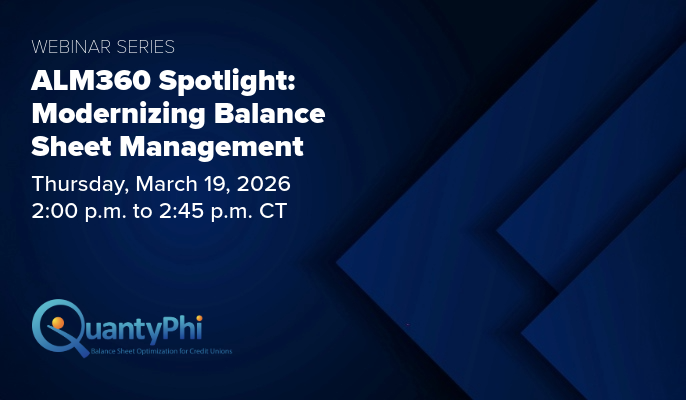
ALM360 Spotlight: Modernizing Balance Sheet Management | Webinar Series
Effectively managing the balance sheet remains a top priority for credit union leaders. QuantyPhi’s ALM360 Spotlight Series is a monthly webinar series designed to showcase how ALM360 brings modeling, analytics, reporting, and strategy together in one integrated platform.
In each 45-minute session, you will see how interconnected tools simplify complex processes, strengthen risk management, and turn data into clear, actionable insight. From real world scenarios to practical takeaways, the series is built to equip teams with smarter ways to optimize balance sheet performance in a changing financial environment.
Register today to gain practical strategies and insights for managing interest rate risk and optimizing balance sheet performance with ALM360. Join us for our next session on Thursday, March 19 at 2:00 p.m. to 2:45 p.m. CT.
Join the QuantyPhi team in 2025 to support our partners and clients at these important events:
Illinois Credit Union League State Legislative Summit
April 14, 2026, in Springfield, IL | Explore moreWisconsin Credit Union League Annual Convention
May 13 to May 15, 2026, in Madison WI | Register hereIllinois Credit Union League Small Asset Size Roundtable
July 8, 2026, in Decatur, IL | Learn more
August 20, 2026, in Wheaton, IL | Event detailsCorporate Central Momentum 2026
October 13 to October 16, 2026, in Madison, WI | Save the date! Registration opens soon.
Financial Reads
Are you looking for some good reading that might help you at work too?
Subliminal: How Your Unconscious Mind Rules Your Behavior
Author Leonard Mlodinow examines how cognitive processes can influence decision‑making and the ways these tendencies may affect outcomes. The book explores common blind spots, approaches for recognizing them, and the underlying reasons they occur.

Damsel in Distressed: My Life in the Golden Age of Hedge Funds
In this behind‑the‑scenes look at the golden age of hedge funds, author Dominique Mielle offers insight into the strategy and evolution of the asset class. The book also includes broader commentary that extends beyond hedge fund operations, alongside an in‑depth discussion of hedge fund practices and experiences.

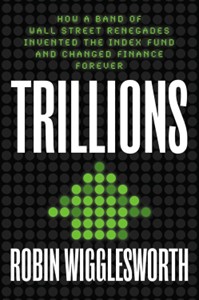
Trillions: How a Band of Wall Street Renegades Invented the Index Fund and Changed Finance Forever
Author Robin Wigglesworth examines the origins of indexing as an investment strategy, highlighting the academics and early proponents who helped shape its development. The book also addresses more recent developments, including proxy battles and considerations surrounding the growth of passive investing.
For more investment reads, check out our QuantyPhi Reads selection.
Spotlight on SimpliCD
Simplify your strategy and amplify returns with SimpliCD.

Are safekeeping fees cutting into your CD returns? Many providers charge additional fees for holding DTC CDs, which can quietly reduce your overall yield. With SimpliCD Investments, there are no safekeeping charges, so you keep the full value of your investment working for you.
SimpliCD provides access to exclusive custodial rates from banks and credit unions, making it a smart and efficient way to manage your CD portfolio. Connect with QuantyPhi to learn how SimpliCD Investments can support your investment strategy.
Stay Up to Date with QuantyPhi
Sign up to receive announcements and other notifications from QuantyPhi.